e3x.nn.activations.gelu
- e3x.nn.activations.gelu(x, approximate=True)[source]
Gaussian error linear unit activation function.
Computes the gated linear activation. If
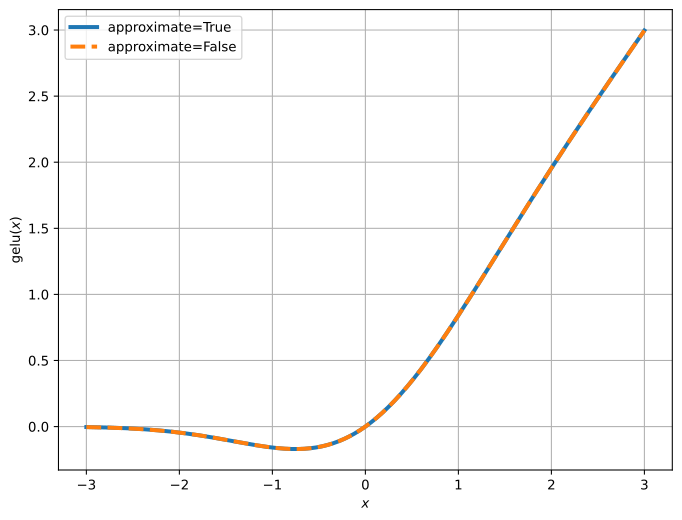
approximate=False, the \(\mathrm{gate}\) function is given by:\[\mathrm{gate}(x) = \frac{1}{2} \left(1 + \mathrm{erf} \left( \frac{x}{\sqrt{2}} \right) \right)\]For scalar inputs, this is equivalent to:
\[\mathrm{gelu}(x) = \frac{x}{2} \left(1 + \mathrm{erf} \left( \frac{x}{\sqrt{2}} \right) \right)\]If
approximate=True, the \(\mathrm{gate}\) function is approximated as:\[\mathrm{gate}(x) = \frac{1}{2} \left(1 + \mathrm{tanh} \left( \sqrt{\frac{2}{\pi}} \left(x + 0.044715 x^3 \right) \right) \right)\]For scalar inputs, this is equivalent to:
\[\mathrm{gelu}(x) = \frac{x}{2} \left(1 + \mathrm{tanh} \left( \sqrt{\frac{2}{\pi}} \left(x + 0.044715 x^3 \right) \right) \right)\]For more information, see Gaussian Error Linear Units (GELUs), section 2.
- Parameters:
x (
Union[Float[Array, '... 1 (max_degree+1)**2 num_features'], Float[Array, '... 2 (max_degree+1)**2 num_features']]) – Input features to which the nonlinearity is applied.approximate (
bool, default:True) – Whether to use the approximate or exact formulation.
- Return type:
- Returns:
The result of applying the nonlinearity to the input features.