e3x.nn.functions.trigonometric.reciprocal_fourier
- e3x.nn.functions.trigonometric.reciprocal_fourier(x, num, kind='shifted', use_reciprocal_weighting=False)[source]
Reciprocal Fourier basis functions.
Computes the basis functions (see
basic_fourierandreciprocal_mapping)\[\mathrm{reciprocal\_fourier}_k(x) = \mathrm{fourier}_k(1-\mathrm{reciprocal\_mapping}(x))\]where \(k=0 \dots K-1\) with \(K\) =
num.Plot for \(K = 5\) (
kind = 'shifted',use_reciprocal_weighting = False):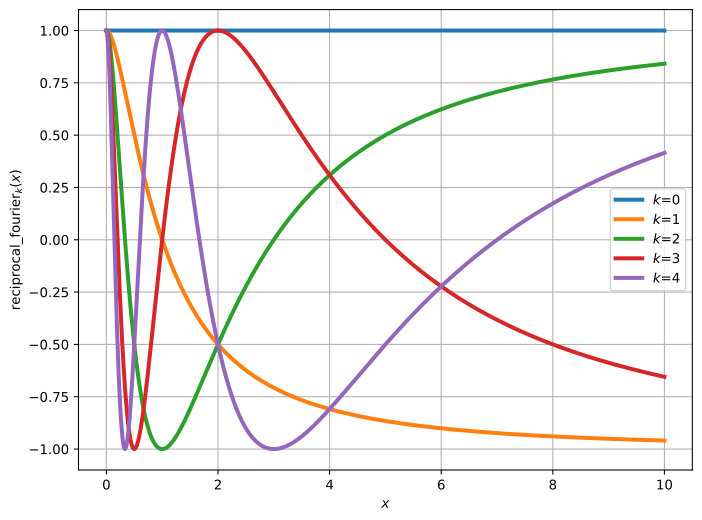
Plot for \(K = 5\) (
kind = 'shifted',use_reciprocal_weighting = True):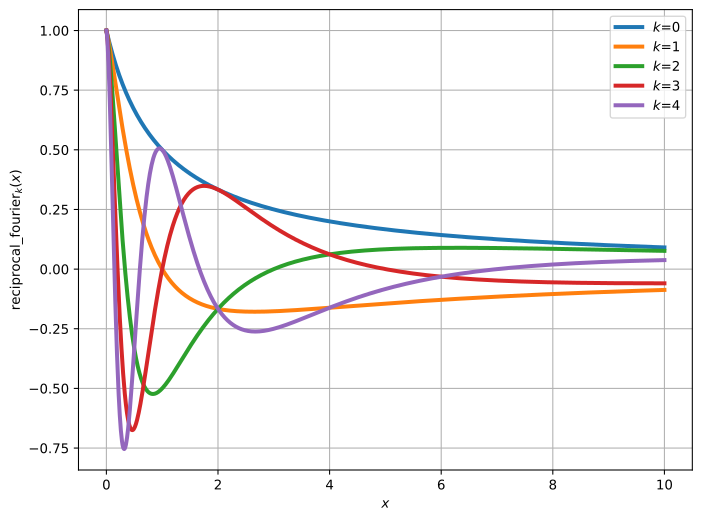
Plot for \(K = 5\) (
kind = 'damped',use_reciprocal_weighting = False):
Plot for \(K = 5\) (
kind = 'damped',use_reciprocal_weighting = True):
Plot for \(K = 5\) (
kind = 'cuspless',use_reciprocal_weighting = False):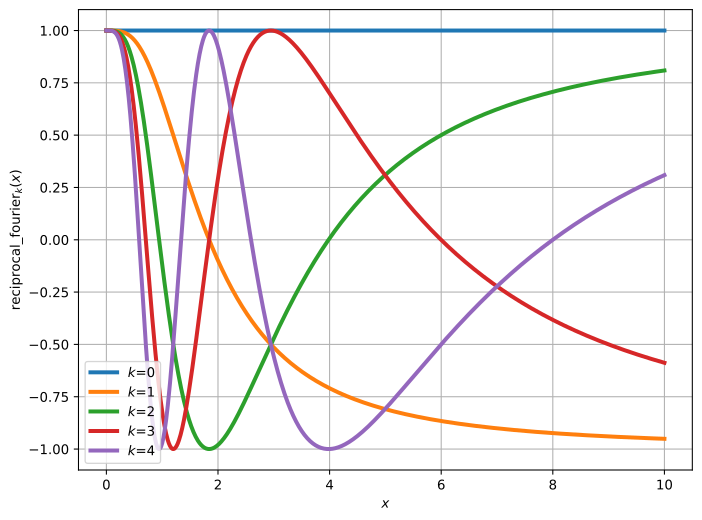
Plot for \(K = 5\) (
kind = 'cuspless',use_reciprocal_weighting = True):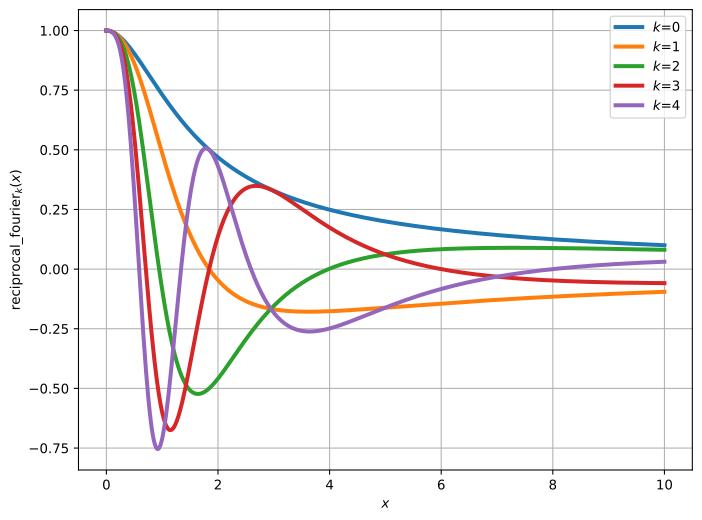
- Parameters:
x (
<class 'Float[Array, '...']'>) – Input array.num (
int) – Number of basis functions \(K\).kind ({
'shifted','damped','cuspless'}, default:'shifted') – Which kind of reciprocal mapping is used.use_reciprocal_weighting (
bool, default:False) – IfTrue, the functions are weighted by the value of the reciprocal mapping.
- Return type:
- Returns:
Value of all basis functions for all values in
x. The output shape follows the input, with an additional dimension of sizenumappended.